Capsula
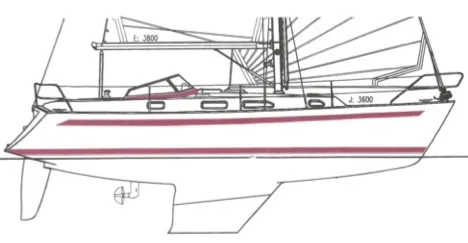
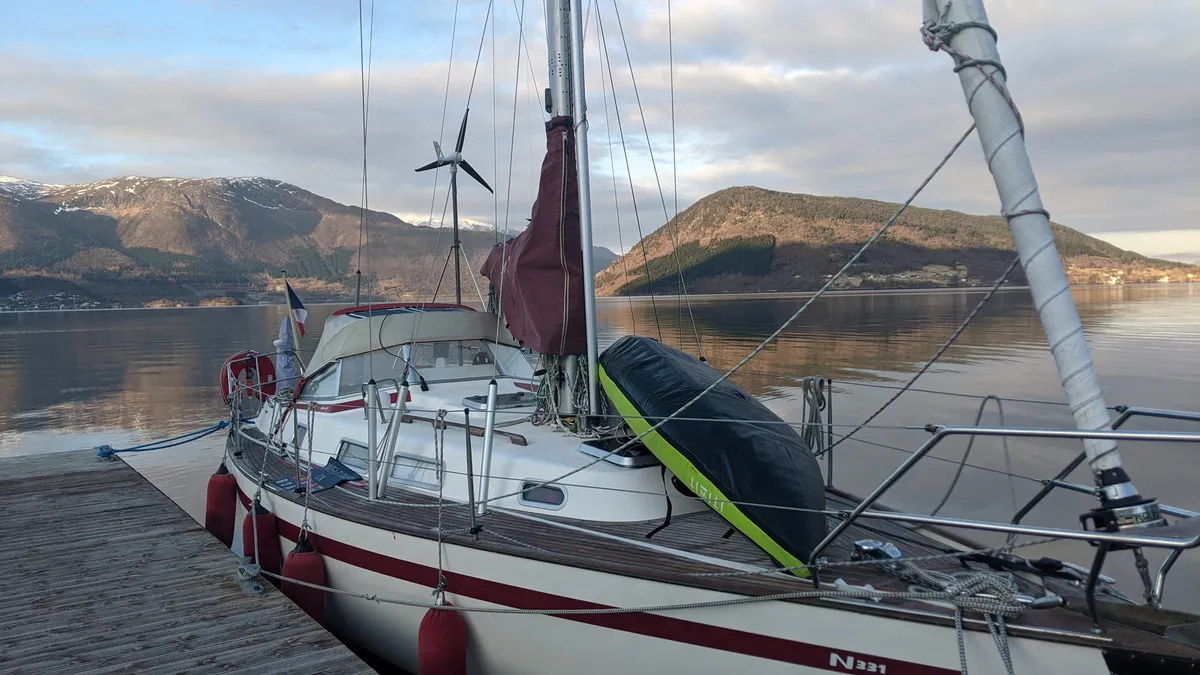
Capsula is our home, our vehicle, our shelter, and occasionally our headache. It’s like a space capsule, but for the oceans. She’s a 10-metre Najad 331, Swedish-built in 2001, and - by modern cruising standards - is considered small (that worried us at first, now it’s one of the things we’re most proud of). She flies a French flag, for practical reasons. We compensated with an Italian name.
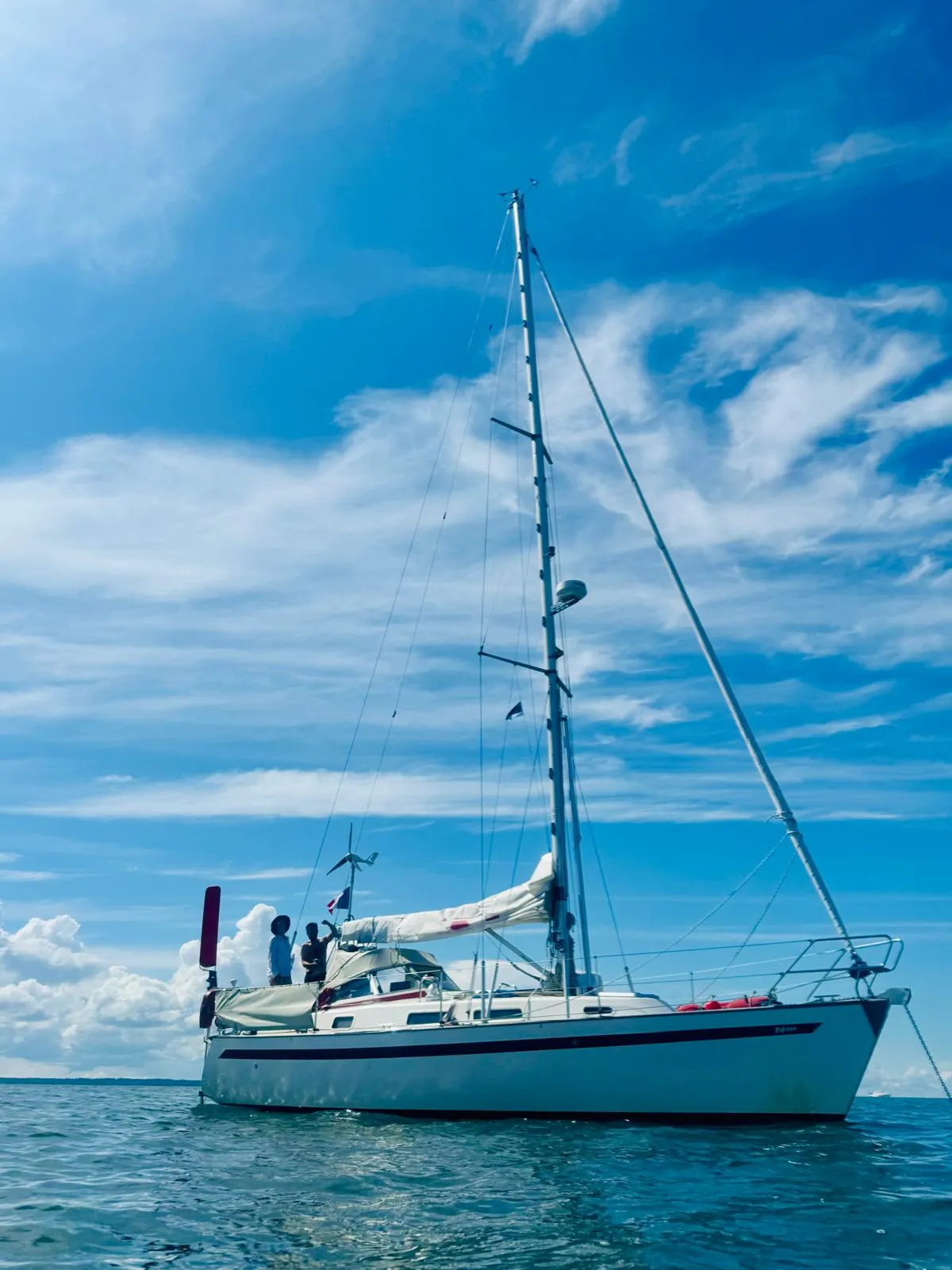
We bought Capsula in north-west Spain in 2021, and since then she’s taken us far enough north to make hitting icebergs a concern, and in remote enough locations to make us very aware of what matters and what doesn’t.
Small boat, on purpose
Among cruising and explorer boats, Capsula is almost always the smallest kid in the gang. We consider it a feature.
Being small forces us to use less, think more, optimise everything, and sail properly instead of defaulting to the engine. Space, water, fuel, gas, electricity - you feel them every day. That awareness shapes how we move, cook, sail, and plan, and we like that.
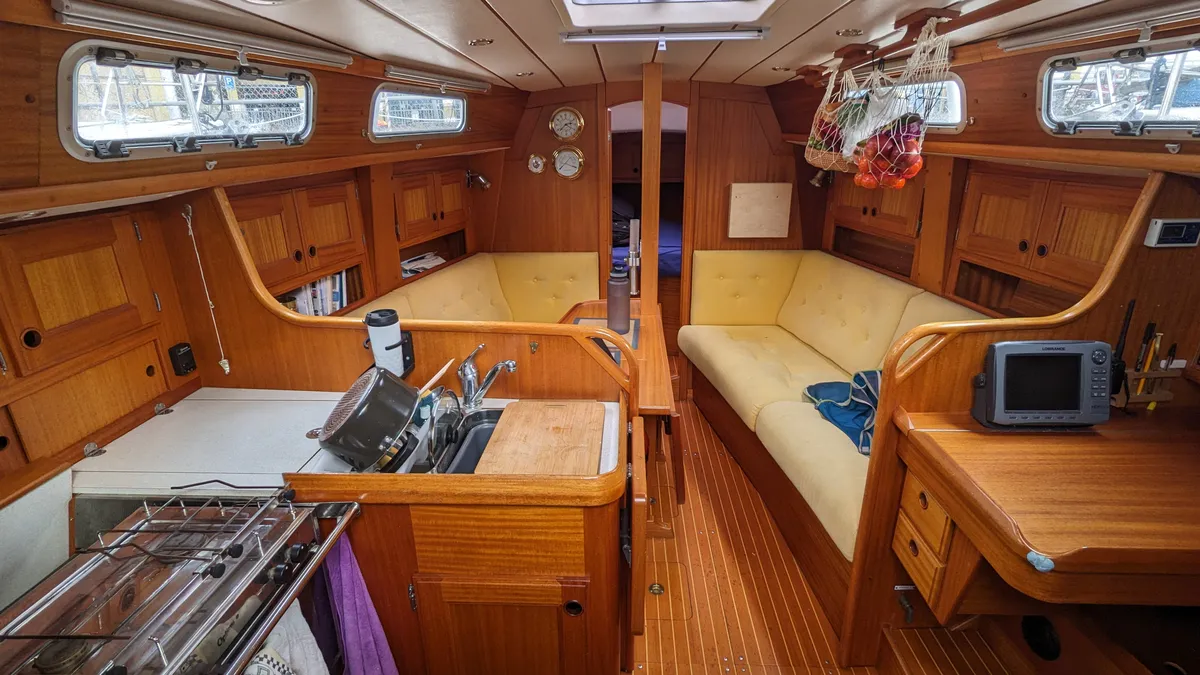
Capsula is just under 10 metres long and 3.26 metres at the widest point, with about 1.85 m of headroom inside.
We can both stand upright everywhere, one of the few advantages we have as short people.
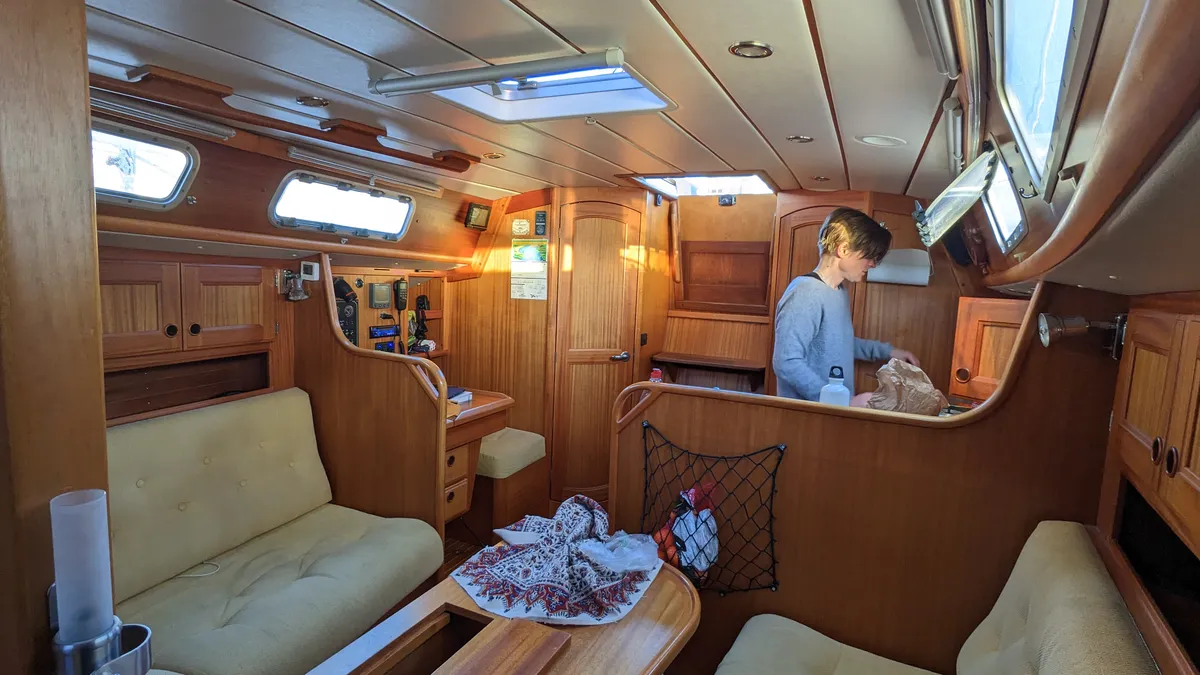
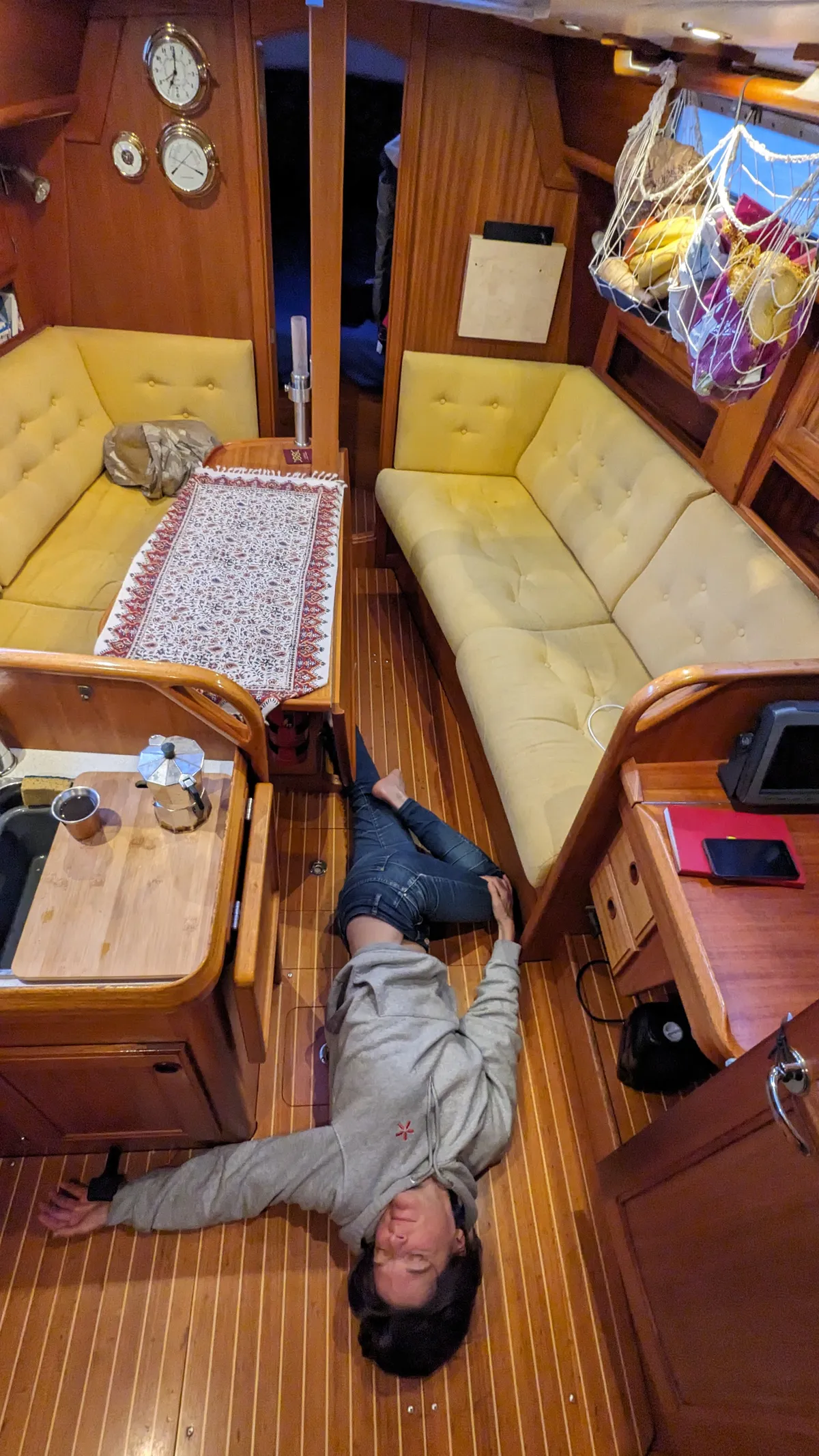
She has two double cabins (one forward, one aft), two settee berths in the saloon, an L-shaped galley, a navigation station, and a single head that doubles as a shower.
She’s rated for 7 people. We’ve never had more than 6 people on board, and we’ve never sailed with more than 5.
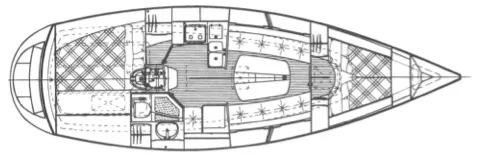
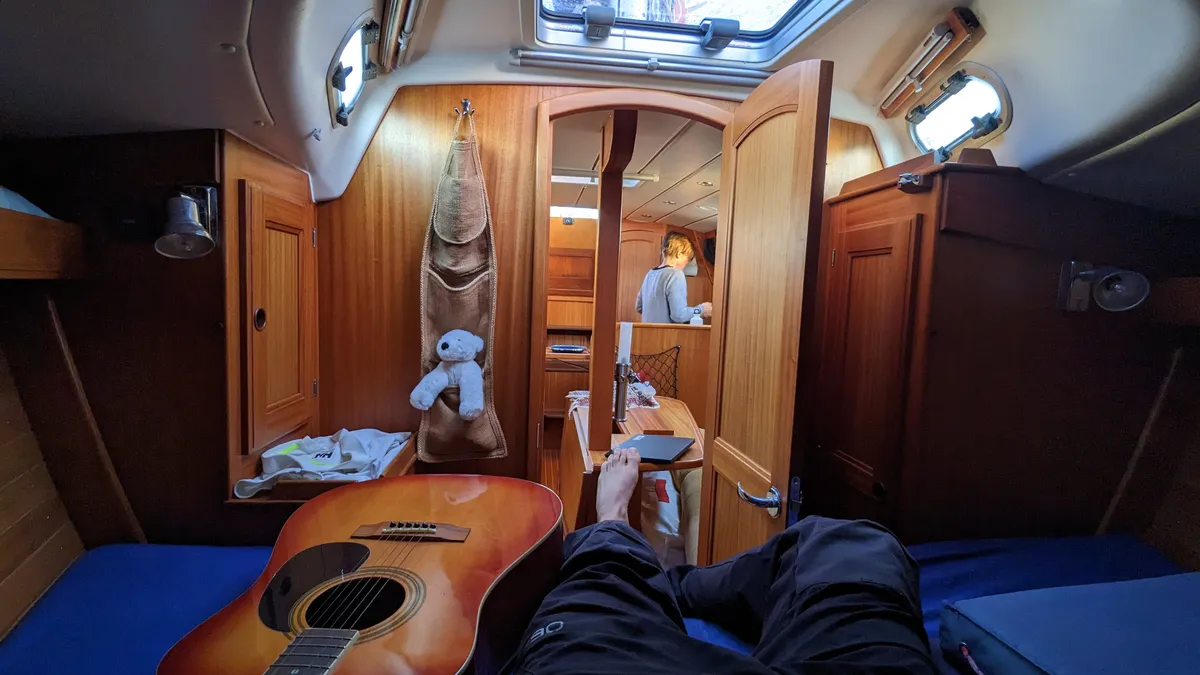
We sleep in the aft (stern) cabin. The bed is bigger, and it’s more comfortable underway. The forward cabin is for guests, because it's less claustrophobic. But underway, we rearrange who-sleeps-where based on who gets seasick
We cook on gas, and we use a thermal cooker a lot. You bring food to a boil, seal it, and let time do the rest. Typically, we cook in the morning with a tiny amount of gas before leaving, and we have a hot stew ready in the evening.
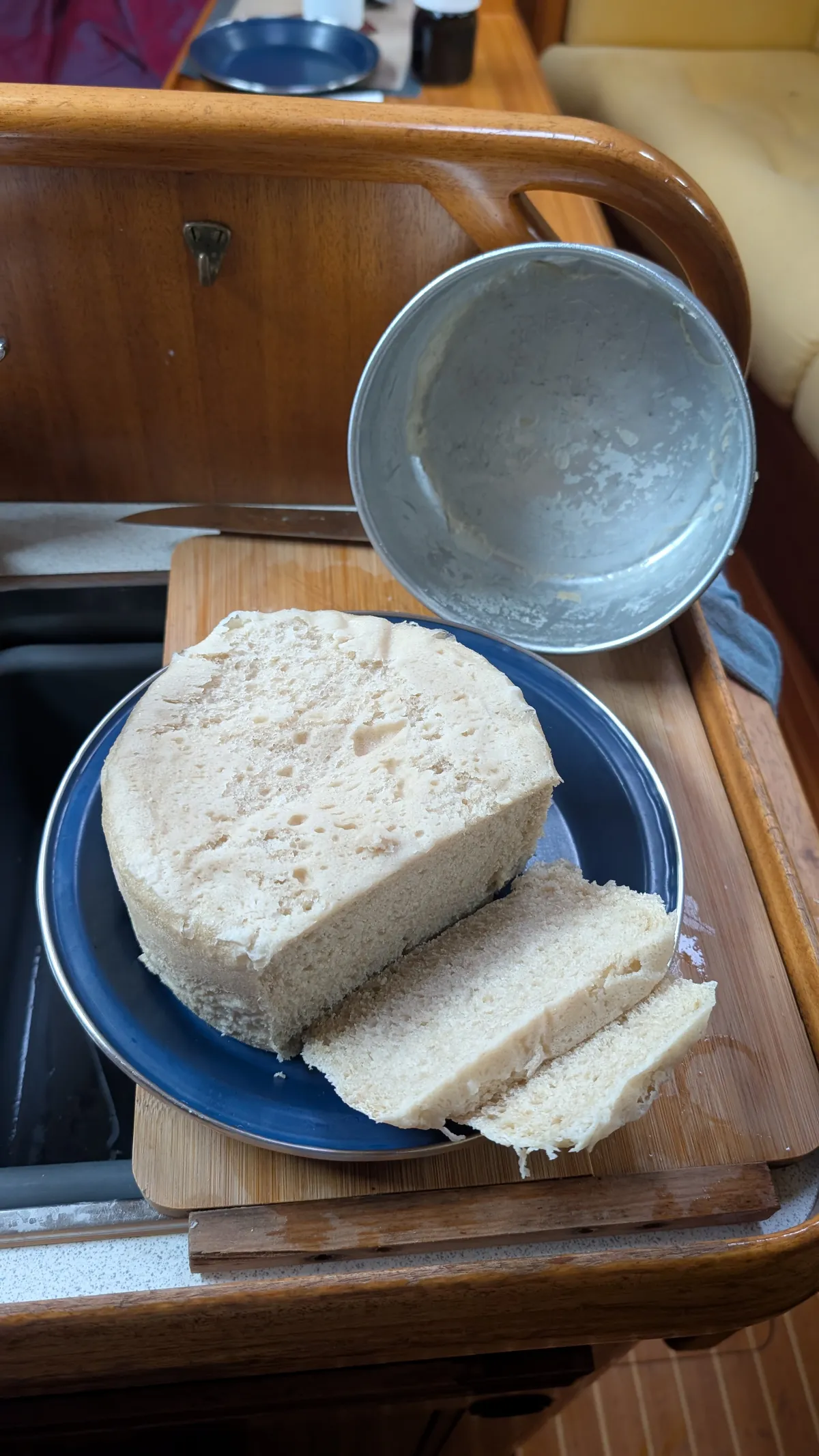
We can only carry two small gas bottles (2.75 kg each). Our gas locker won’t fit anything much bigger. We also have an adapter to connect small camping canisters (the ones you find in many camping shops) to the boat’s gas system. It’s not a cheap way to get gas, but it’s good to know we can get gas virtually everywhere in the world.
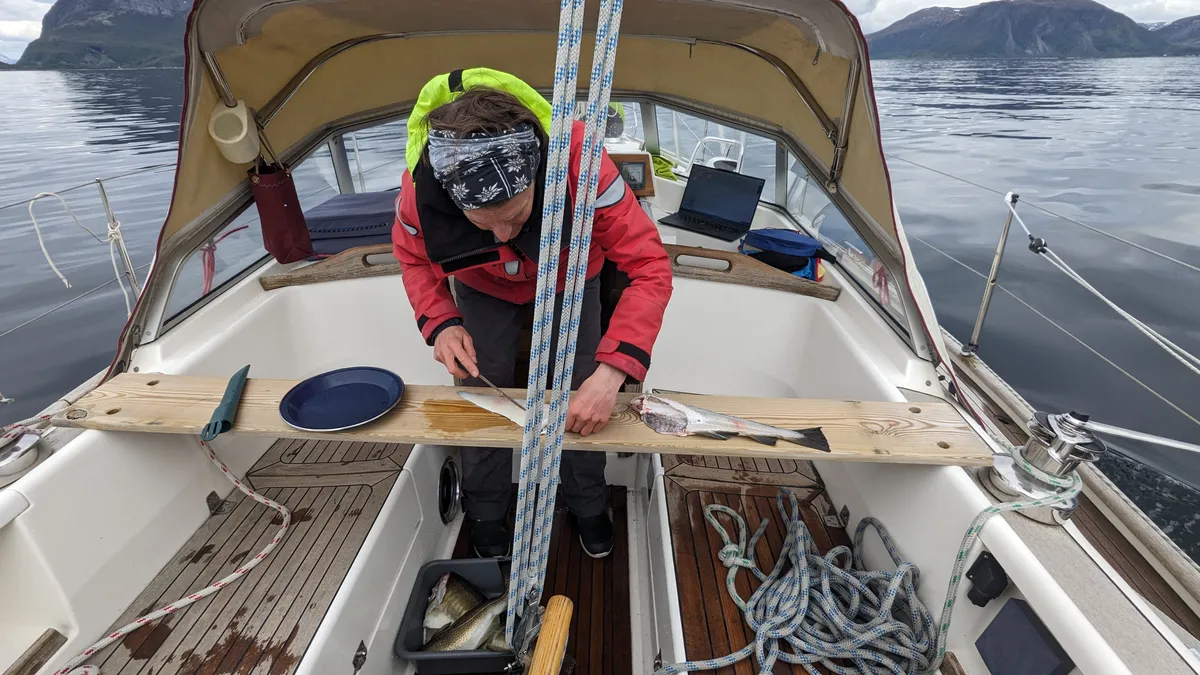
Our fridge is top-loading, small, and efficient. It’s either a fridge or a freezer, not both. We use it as a fridge, mostly for dairy products and the fish we catch. We’re not big meat eaters, so a freezer is less important for us.
We poop in a very small “bathroom” (the head), which is a wet room, like on many boats this size, with a manual marine toilet and a sink.
We shower in the same bathroom, using the sink tap, which ingeniously extends into a shower head. We have the luxurious option of hot water, made either via the engine (after about 20 minutes of running) or via an electric heating element (which, of course, we can only use when connected to shore power).
Water
We carry 170 litres in the main tank, plus 9 x 10 L foldable containers distributed around the boat. Foldable containers, when full, fit in awkwardly shaped spaces, when empty, take almost no space, and they are easy to move around. Our real-world water use for two people is 7 L/day if we’re careful and up to 12 L/day if we both shower every two days. That gives us 3 to 5 weeks of autonomy, depending on how civilized we feel. Which is not much. But where we’ve sailed so far, water was easy to find. Sometimes, it even falls from the sky.
Electrical power
We have a 12 V system with 255 Ah AGM batteries (we have never discharged them more than 50%). We charge the batteries via 200 W of solar panels, a 400 W rated wind turbine, shore power when we can and the engine alternator. So far, we’ve never had to start the engine specifically to charge batteries.
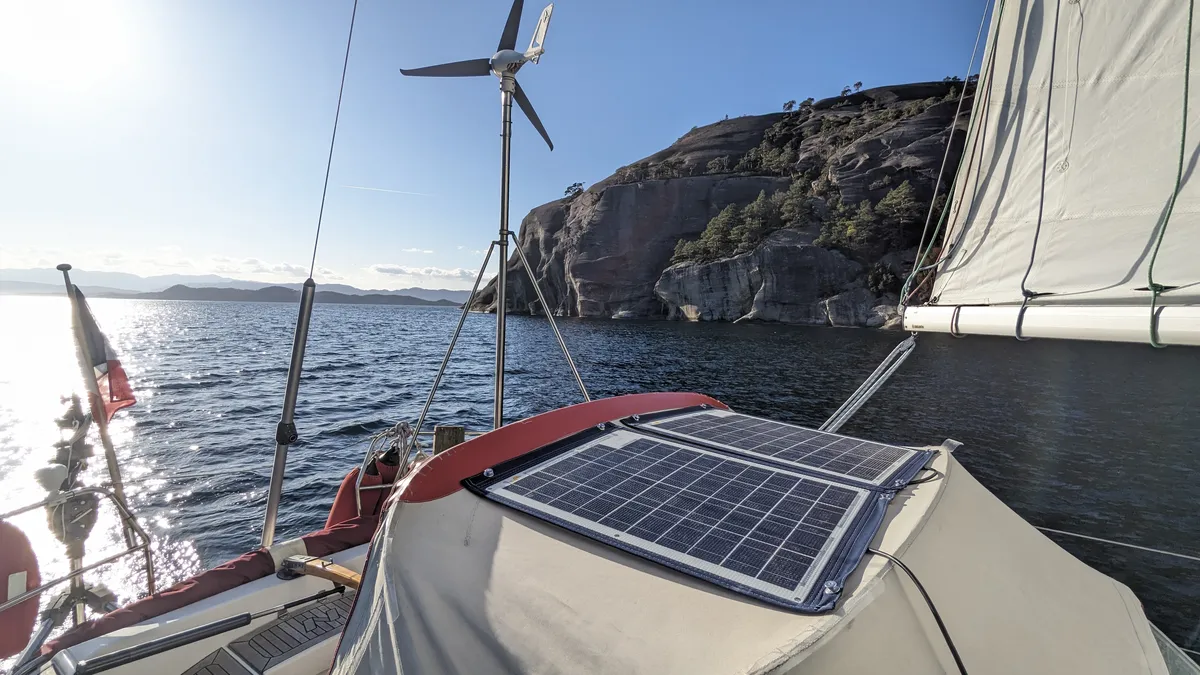
We also have a 1.6 kVA inverter (rarely used, but great as backup) and a portable isolation transformer (110 to 220 V) for North America shore power. We use electricity sparingly. The main consumers are the fridge, the boat's instruments, the diesel heater (especially at startup), our laptops, and Starlink. The anchor windlass obviously draws a lot, but it’s used normally with the engine on. That said, we enjoy arriving and leaving anchorages under sail, old-school style, and we drop the anchor manually. Anne has even docked on pontoons under sail twice: once because we had an engine malfunction and once because she thought she could.
Heating
We have a Webasto diesel heater to heat the living space. When it works, it does a great job. Turn a knob, get heat. No bulky stove, no lost cabin space. That’s good on a small boat. The downside is that it needs electricity to work. We don’t love that dependency. We use this diesel heater when it’s cold, even underway, and for drying clothes.
Sailing rig
Capsula is a fractional sloop.
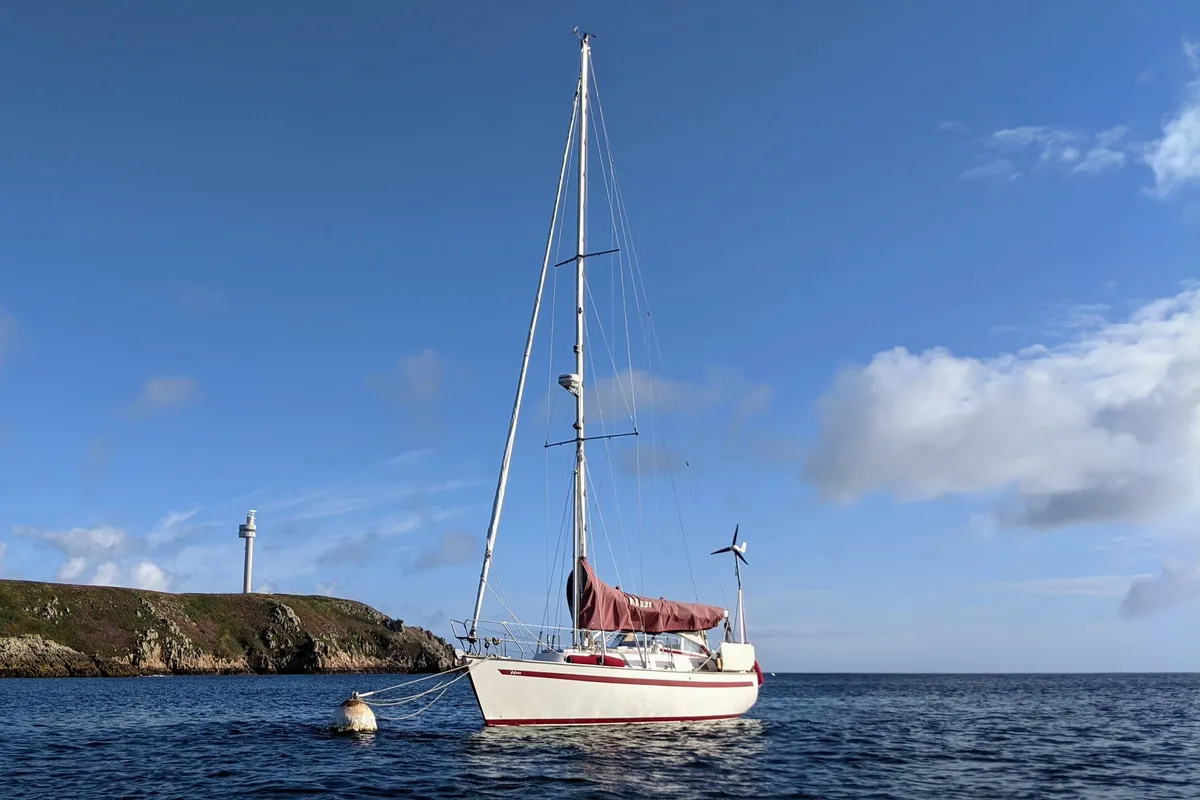
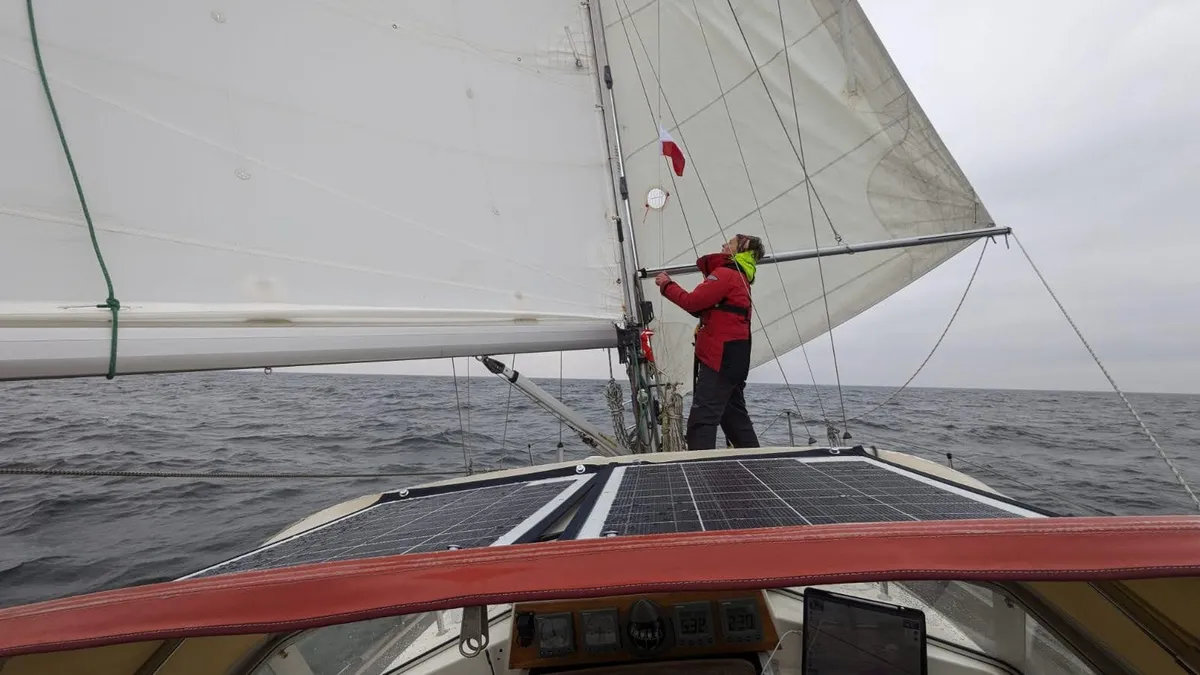
Our working sails are a battened mainsail (with a surprisingly convenient Dutchman system for flaking the sail) and a high-aspect laminate jib.
Downwind, we pole out the jib. The boat is light for a cruiser, and this setup works well. In very light downwind conditions, we miss having a spinnaker, but we also haven’t found the storage space we’re happy to give up.
We also carry an old jib as a spare sail that can double as a twin headsail and two storm jibs (12 m² and 8 m²). We’ve used the larger one once, in an emergency. The smaller one, thankfully, never.
Engine propulsion
The engine is a Volvo Penta MD2030, 28 HP, with a stock 60 A alternator. Fuel on board is carried in a 92 L main tank, 95 L worth of jerrycans stored in our large cockpit locker. So far, we’ve never needed the jerrycans. Even sailing to Svalbard, we wouldn’t have dropped below half the main tank. Still, safety margins are important.
Our average fuel consumption is 1.65 L/h cruising at 1800 RPM (5.5 kn in flat water) and 0.3 L/h for the heater.
Our diesel autonomy is about 40 to 80 days, depending, of course, on how much we move and the heater use. We’re happy with how little we motor. By our logs, we’ve done only about a quarter of our miles under engine, the rest under sail alone. For non-sailor, this may not mean much, but when talking to other cruisers, they all seem to use the engine much more.
Anchoring
Our anchor setup is a 15 kg original Bruce anchor, 45 m of 8 mm chain, and 40 m of 16 mm nylon rope. We’ve never dragged, fouled, or had an issue, up to 35 kn of wind, but we won't pretend luck wasn't involved.
Navigation
We have the original ST60 instruments, connected to an NMEA 2000 network via a converter. All instrument data is broadcast over Wi-Fi, so any device that can join the Wi-Fi network with the right app can access GPS, wind, depth, speed, etc. We use OpenCPN on 3 laptops and 3 phones, and we use one of the laptops as a primary navigation chart plotter. We also have a fixed marine chart plotter with its own GPS and an iPad as backups (but we don’t usually buy charts for these). We think the level of redundancy we have compensates for not having a traditional “marine” setup. In fact, we find that using multiple operating systems, on multiple devices, with multiple chart sources is more robust, flexible, and also cheaper than proprietary alternatives.
Communication
We have a fixed and a handheld VHF radios, an AIS transponder, a rudimentary NAVTEX, an LW/MW/SSB radio receiver, and an EPIRB for emergencies. We added Starlink reluctantly. For a long time, we resisted it. Eventually, we accepted that proper internet access is also a safety feature. We use it sparingly underway (mainly to preserve power). It’s not a fixed installation. We also have an Iridium GO, now mostly redundant. The ecosystem is outdated, the apps aren’t maintained, and the cost no longer makes sense. It feels like a technology being slowly milked to death.
The tender (or lack thereof)
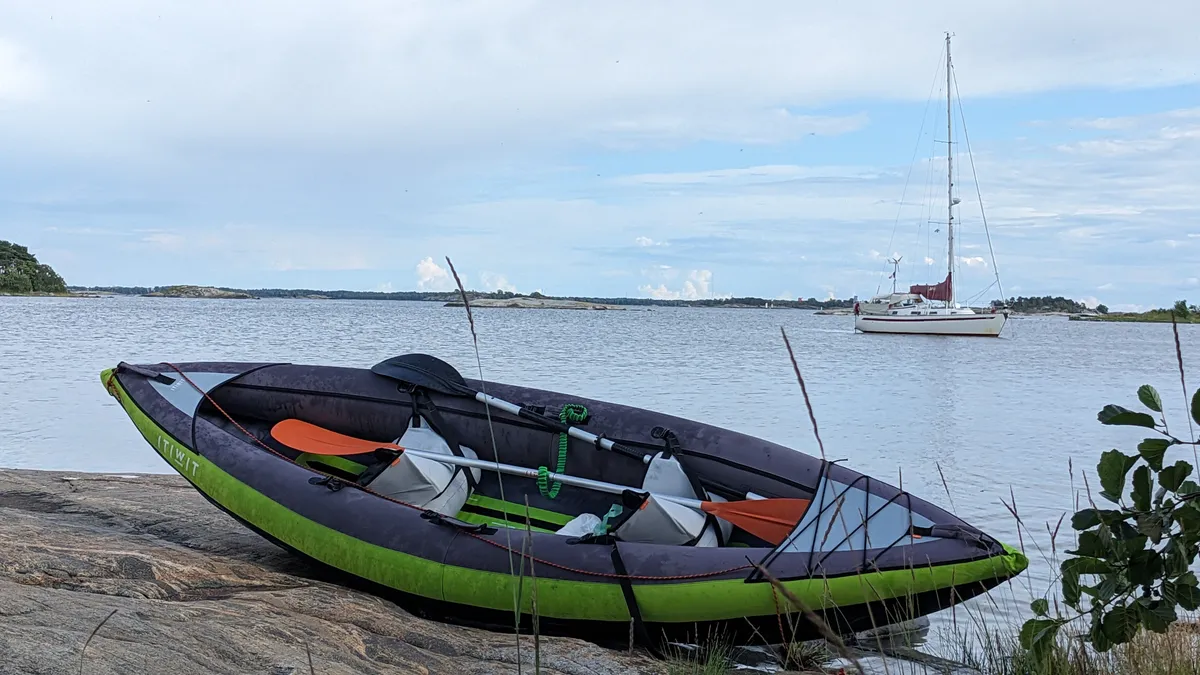
We use an inflatable kayak as a tender. For a small boat, it’s brilliant: easy to store, no extra fuel, no outboard to carry and to maintain, and very efficient to paddle. The downside is that you can’t tow the boat with it in an emergency. A proper dinghy and outboard could. We’ve accepted that trade-off.
Why we chose Capsula
We’ve already said it, but it’s worth repeating: we wanted a small boat. It forces discipline, rewards good habits, and punishes sloppy ones. It makes you understand what is essential. For the same budget, we would always choose a smaller, well-built boat over a larger, less well-built one. Capsula is compact, but serious. Nothing feels flimsy and nothing feels fake. A small boat also left us with more money to quit our jobs and go sailing earlier.
From the start, we were drawn to colder, harsher cruising areas like northern latitudes and shoulder seasons. Scandinavian boats like Najads have a long track record there. They have solid laminates, sensible layouts and conservative engineering.
Najad boats have been around for decades. They age well, hold value, and tend to be worth upgrading rather than replacing. When we spend money improving Capsula, it doesn’t feel like polishing a disposable object. It feels like investing in something that will still be relevant years from now. It makes a difference when we’re deciding whether a refit or upgrade is “worth it”.
There’s also a much simpler reason. When we decided we wanted a boat, this was the right boat, in the right place, at the right time. North-west Spain was convenient. The boat was sound. The timing worked.
What we’d change
Less draft
We’d love a shallower draft or a retractable keel. Being able to reach shallower anchorages, explore more tidal areas, and dry out safely would open a lot of interesting places. That kind of setup is common on aluminium boats, which we seriously considered. And that brings us to why we didn’t go that route.
Aluminium boats are brilliant in many ways. But they come with higher costs, more specialised repairs, corrosion management that requires more attention, and fewer options in very remote places if something structural goes wrong. We liked the idea of aluminium. We even bought an aluminium boat before Capsula but we’re glad we managed to reverse that sale (story for another time).
Stefano: less precious
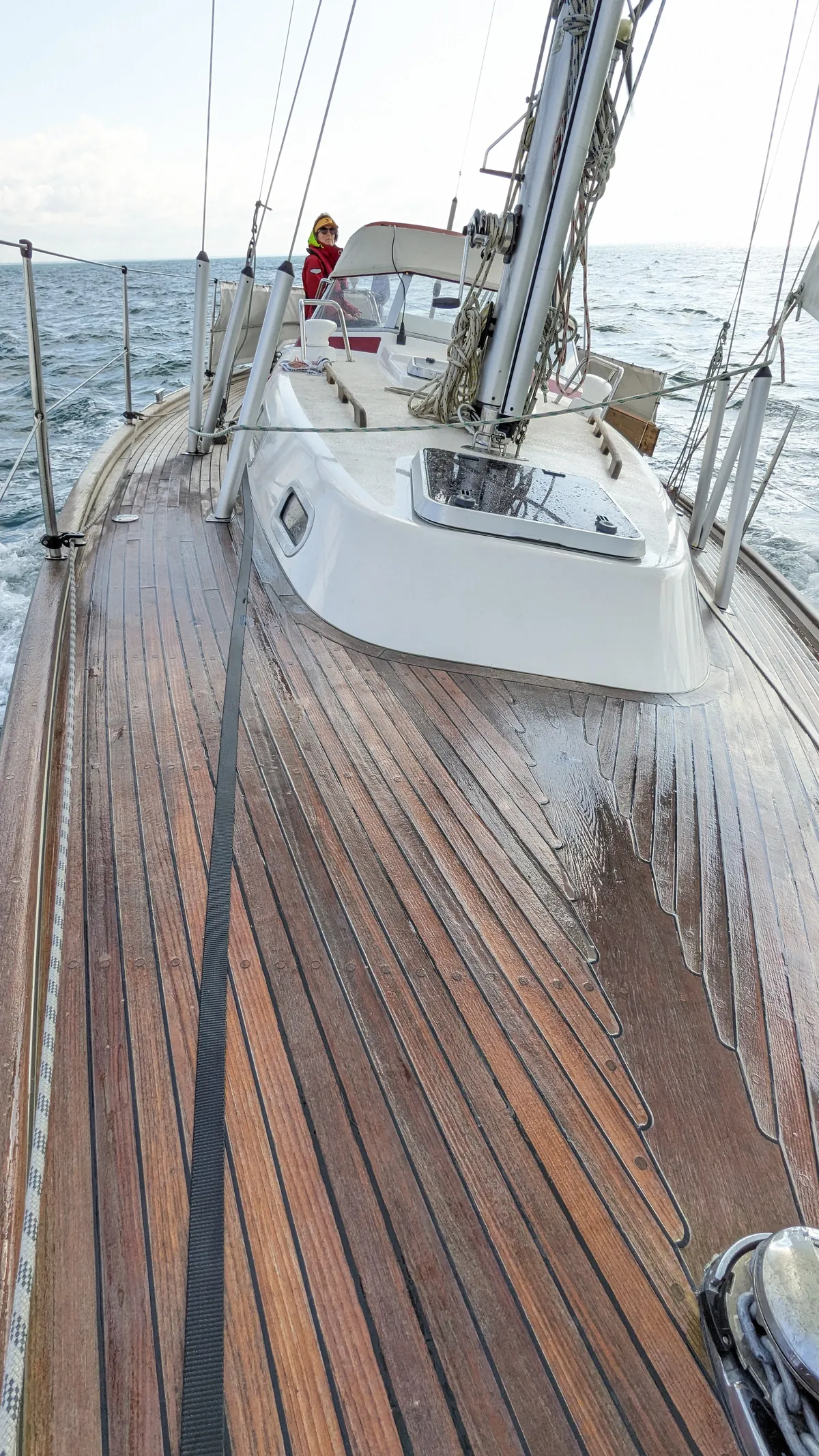
Capsula is beautifully finished. Sometimes too beautifully. Stefano would love a boat that’s a bit more spartan, where drilling a hole doesn’t feel like sacrilege, where accessing a bolt doesn’t require dismantling fine joinery, and where you don’t hesitate before modifying something because you can only make it look worse. Capsula can feel like a boat that expects you to ask permission before changing her. That’s not always ideal for a long-term cruising home.
Anne: a teeny-weeny more space
Anne enjoys the beauty of Capsula, she feels proud of her and loves coming back to her. But she would happily accept a little more room, a bit more breathing space, and a layout that’s slightly more comfortable for guests. Not because Capsula is uncomfortable, but because hosting people on a small boat always involves compromises. A few extra cubic metres would make it easier for friends and family to want to come visit us.
Fossil-fuel-free dreams
If we could start from scratch, we’d love a boat designed to be entirely fossil-fuel free. A boat where energy generation and recovery are a core principle, and where propulsion, cooking, and heating are all electric.
We imagine a boat with an integrated large amount of solar power, wind turbines, and hydrogeneration while sailing; the most energy-dense batteries realistically available; electric cooking; excellent insulation so heating is rarely needed or its only localised; redundancy via two separate electric drives and propellers; multiple ways to generate and store energy, so no single failure can immobilise the boat; no engine, no gas. Maintenance and logistics would be simpler, and we could cruise farther without worrying about refuelling or finding cooking gas.
Of course, this is still a dream. Technological gaps remain in achievable energy density, cold-weather performance and long-range autonomy. To make it work today we’d likely have to reduce our cruising ground.
But the technology keeps evolving, and we like imagining what the next perfect boat for us could be.
Capsula in numbers
- Water autonomy: 35 days
- Cooking gas autonomy: 5 months
- Diesel autonomy: typical use 40–80 days, ocean crossing ∞
- Range under engine alone: 600 nm
- Range motor and sailing coastal (typical use): 1700 nm
- Sailing speed in fair conditions: 5.5 kn closed hauled, 6.5 kn reach, 7 kn broad reach
- Max people on board: certified for 7, can sleep 6
- CE category: A
- Length (LOA): 9.98 m, 32’8”
- Beam max width: 3.26 m, 10’8”
- Length waterline (LWL): 8.14 m, 26’8”
- Draught: brochure 1.68m, 5’6”, measured: 1.8m, 6ft
- Mast Height from DWL (air draft): 15.20 m, 49.87 ft
- Displacement: 5 t (brochure), 5.3 t, 11,684 lb (other sources)
- Ballast: 2.1 t
- Mast Length: 12.25 m
- Boom length: 3.8 m
- Rigging: 19/20 fractional Sloop
- Sail area (reported): 50.00 m2, 538.20 ft2
- Main Sail: 26.5 m2, 280 ft2 (fully battened)
- Working jib: 24 m2, 258 ft2
- Hull type: Polyester, fin keel (lead) with spade rudder
- Displacement/Length ratio: 274.04
- Sail-Area/Displacement ratio: 16.78
- Ballast/Displacement ratio: 39.63
- Displacement/Length ratio.: 274.04
- Comfort Ratio: 26.95
- Capsize Screening Formula: 1.89
- Immersion rate: 177kg/cm, 995 lbs/inch
- Wet bottom surface: 30m2, 322 ft2
- Diesel tank: 92 l, 24 gals
- Fresh water tank: 170 l, 45 gals
- Grey water tank: 40 l